In 1926, the Aurelius brothers started a business on the family farm in Braham, Minnesota with big ideas and the the inginuity to bring those ideas to life.
There was no grand vision statement on the wall and no talk of legacy. Just basic tools, simple machines, the desire to solve problems, and a willingness to work hard.
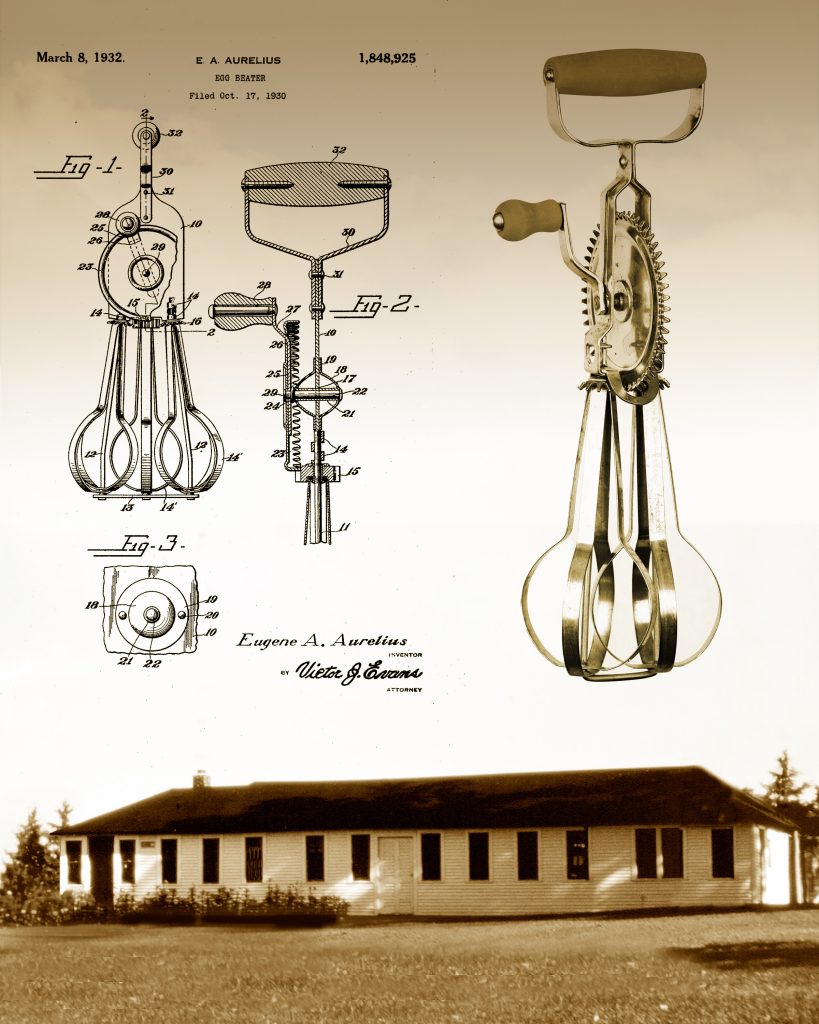
What started with simple products like hand-crank egg beaters grew step by step.
Building those products required tooling, which led to tool and die work for other shops and inventors, then to contract manufacturing, and eventually to hydraulic cylinders. Through each stage, the focus remained the same: solving practical problems and delivering what customers needed, when they needed it.
If it didn’t exist, you made it. If it had to last, you built it heavier than necessary and slept well at night.
That mindset has carried the company through a full century.
In the Early Years
Aurelius was founded by brothers Eugene and Bernard Aurelius. Gene ran the shop, building parts and assembling products. Ben handled the sales side, taking those products to mercantile stores and customers who needed reliable tools, not sales pitches. Like many Midwestern shops of the era, the company started small, likely in a modest outbuilding on the family farm, and grew one job at a time.
Aurelius was exactly what the region needed: a dependable fabrication and machining shop. Agriculture, light industry, repair work, small production runs. Metal in, working parts out. During hard economic times, including the Depression and the war years, survival meant flexibility. You built what customers needed, not what was fashionable.
Which is how a company best known today for hydraulic cylinders once made egg beaters.
Yes, actual hand‑crank egg beaters.
Cast components, machined shafts, simple gearing. Nothing exotic. Just well made. The kind that didn’t wobble, didn’t strip gears, and often outlived their owners. They worked because the people building them understood precision, fit, and durability.
Those same principles apply whether you’re beating eggs or moving several tons of steel with hydraulic force.
As the business matured, Aurelius became known for prototyping, tooling, and contract manufacturing for other inventors and manufacturers. A key relationship developed with Dahlman’s, where Aurelius helped prototype and manufacture mechanical potato harvesters. That work pushed the shop into heavier equipment, tighter tolerances, and more demanding applications.
In the 1950s, Dahlman’s came back with a new request: hydraulic cylinders. That project marked Aurelius’s entry into hydraulics. Through the 1960s and 1970s, the company balanced contract manufacturing with the production of agricultural tie‑rod cylinders. By the early 1980s, Aurelius made a deliberate transition to focus fully on custom welded hydraulic cylinders.
That focus was intentional. The company stayed narrow and got very good at it.
Following World War II, Wendell Nelson apprenticed with Gene Aurelius, eventually taking over day-to-day operations. In the early 1960s, Wendell purchased the business from Mrs. Aurelius and continued to grow it with the same practical, no-nonsense approach that defined its early years.
Over the years, Aurelius Manufacturing became an important part of the Nelson family, with several family members contributing to the company. Wendell’s sons, Conrad and Loren Nelson, devoted their careers to Aurelius and played significant roles in building and leading the business. Their skill, hard work, and dedication helped drive the company's growth and development, carrying Aurelius from its earlier manufacturing roots toward the company it would become.
Like Gene and Ben before them, the Nelsons built the business by solving problems, improving how things were made, and taking care of customers. Their contribution helped preserve the character of Aurelius while laying much of the foundation for the company that exists today.
Today, Aurelius Manufacturing designs and builds custom welded hydraulic cylinders for mobile equipment and specialty industrial applications. Our standard capability includes bores from 1 to 10 inches, rod diameters from 3/8 to 5 inches, stroke lengths up to 20 feet, and operating pressures up to 5000 PSI. We support a wide range of cylinder types, including double acting, displacement, rephasing, double rod, rod fed, spring extend and retract, cushioned, telescopic, and specialized designs that do not fit neatly into a catalog.
We offer extensive porting and mounting options, integrate valves directly into the cylinder when it makes sense, and work closely with OEM engineers to ensure the cylinder fits the machine, not the other way around. Our customers range from large equipment manufacturers to specialty builders solving one very specific problem.
What has not changed is how we approach the work.
We still start by listening. We still ask how the machine is used, where it operates, what breaks first, and what cannot fail. We design for durability, fit, and function with the goal of providing a solution that fits seamlessly into the customers application.
Over the last several decades, technology has given us better tools. We use modern CAD and FEA to validate loads, buckling, and fatigue. We apply improved materials, rod coatings, and internal surface finishes to extend seal life and resist corrosion.
We build tighter process control into machining, welding, and assembly so that unit one and unit one thousand behave the same way.
We build cylinders that work in mud, dust, cold, heat, vibration, and long days that never show up in a brochure.
More recently, Aurelius has added smart cylinder technology. Embedded position sensing, pressure feedback, and closed loop control capability allow modern machines to be more precise, more efficient, and easier to diagnose. The cylinder still does the same job it always has. It just has the ability to communicate with the control system.
We have also expanded our integrated solutions: pad‑mounted valves, port blocks, and multi‑directional porting designed directly into the cylinder. The result is fewer hoses, fewer fittings, fewer leaks, and cleaner machine layouts. OEMs appreciate it. Service technicians appreciate it even more.
Through all of this, Aurelius has remained in Braham, MN.
The building has changed.
The equipment has changed.
The expectations have changed.
Our values have not.
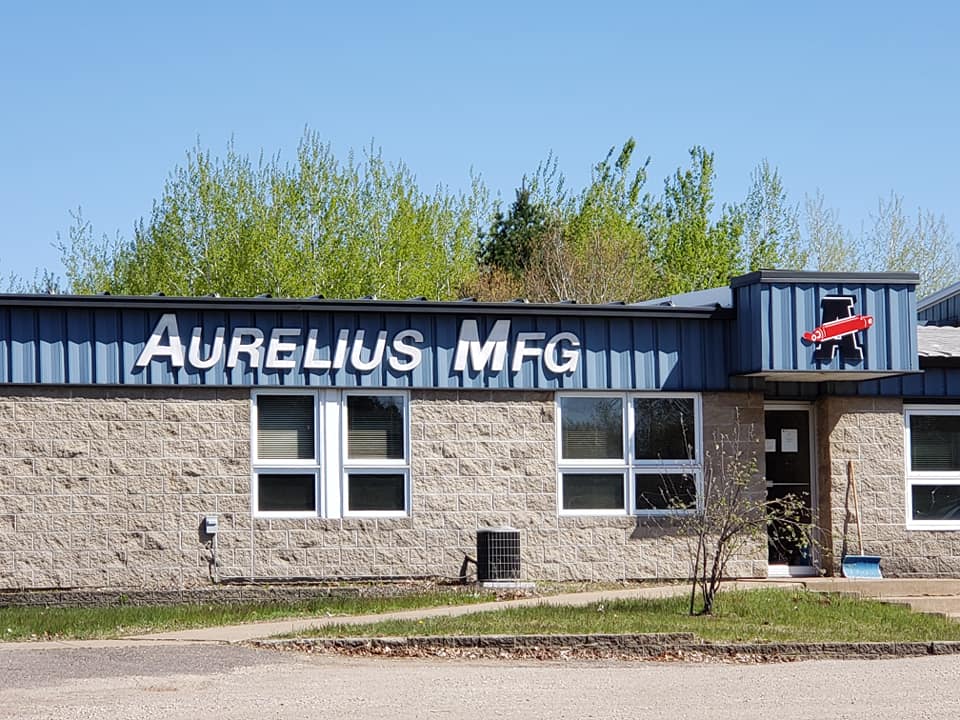
Our location at 220 SW 8th Street, Braham, MN, 55006
Partly due to our rich history and values, we do not chase trends for their own sake. We do not build things we would not stand behind. We do not pretend every application is the same. We build cylinders that work in mud, dust, cold, heat, vibration, and long days that never show up in a brochure.
In 2026, Aurelius Manufacturing celebrates 100 years in business.
That milestone belongs to a lot of people: the machinists, welders, engineers, inspectors, and assemblers who cared about doing it right; the customers who trusted us with their machines; the partners who challenged us to improve; and the generations before us who believed that durability and honesty were competitive advantages.
One hundred years is not about nostalgia. It is about continuity. About doing fundamentally sound work long enough that it earns a reputation. About understanding that whether you are machining an egg beater shaft or designing a 5000 PSI hydraulic cylinder, the rules are the same.
Build it right. Make it last. Take care of the customer.
That philosophy got us through the first century. We plan to keep it for the next one.