Saltwater finds every weakness. A marine cylinder is designed knowing that.
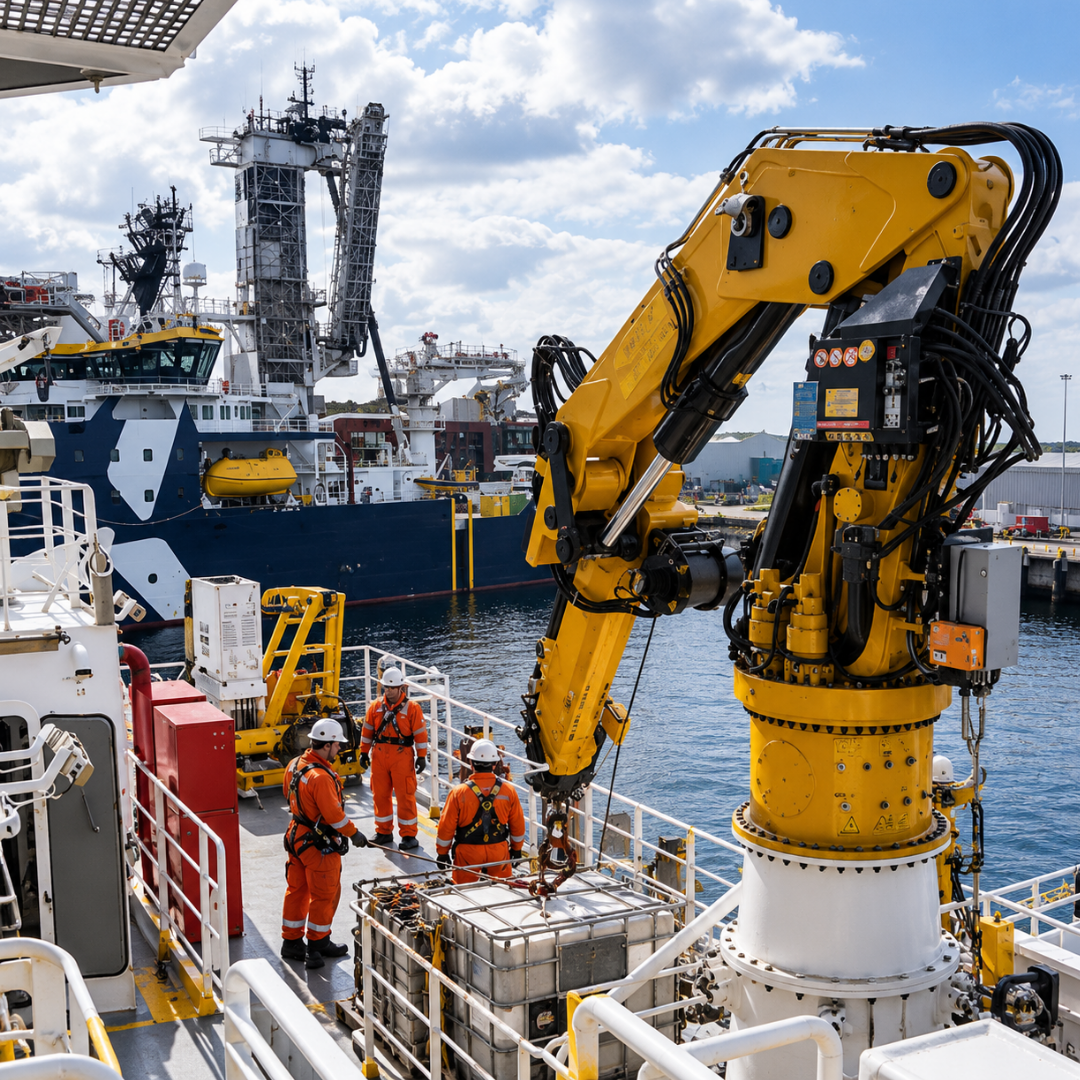
Marine equipment works where steel and salt water meet. Deck cranes lift cargo while the vessel rolls, hatch covers fold open over loaded holds, steering rams hold a rudder against the sea, and dock ramps follow the tide up and down. The cylinders behind these functions live in spray, standing water, and air that corrodes anything left unprotected.
Getting service help is not always simple, either. A vessel may be days from port, and a marina lift or ferry ramp may be the only way on or off. Cylinders need to keep working between maintenance windows and be practical to service when the window comes.
Marine equipment manufacturers work with Aurelius Manufacturing on welded hydraulic cylinders designed for the specific load, the motion of the vessel or dock, and the conditions at each mounting location.
Designing deck, dock, or steering equipment? Loop Aurelius in while mounting points and space claims are still open.
Marine Applications
Marine cylinders work on deck, below deck, and along the shoreline. Some handle heavy cargo loads with the vessel in motion. Some position steering or access equipment with precision. Others sit partly submerged for most of their working life.
These examples are a starting point. Any marine function that lifts, folds, steers, locks, or positions can be reviewed the same way.


Marine applications draw on several cylinder configurations. The right one depends on the motion, the circuit, and how much of the cylinder sits in spray or water.
Two-way hydraulic work for crane luffing, hatch folding, and steering rams.
A rod out each end, a natural fit for balanced steering cylinders that need equal area in both directions.
Spring-applied functions such as winch brakes that engage when pressure is removed.
Holding and counterbalance valving at the cylinder for crane and davit loads.
Softer arrival at full travel for hatch panels and heavy folding sections.
Feedback for rudder angle, crane geometry, and ramp position.
Design Considerations
Marine cylinders face more than water. Dynamic loads from vessel motion, classification society rules, and long stretches between maintenance windows all shape the design.
Settle these points with Aurelius early in the project.
Replacing corroded or leaking cylinders more often than you should? Show us the installation, and we will help work out a better design.
Why Aurelius
Tell us where the cylinder sits, what it lifts, and how the vessel moves. That shapes everything else.
Catalog cylinders can serve some marine functions, especially in sheltered locations. Custom welded designs become the better path when a crane, hatch, or ramp needs mounts and porting matched to its structure, when exposure demands careful attention to materials and sealing, or when valving and position sensing belong on board the cylinder.
Aurelius engineers work through the loads, motion, exposure zones, fluid, and maintenance access with your team. What comes out of that work is a cylinder matched to the vessel or waterfront installation, without parts it does not need.
Before any machining, incoming tube and rod get a finish inspection, and flawed material is refused. No cylinder ships without a test, and the people who build them tend to stay for the long haul.
With a history that reaches back to 1926, Aurelius brings a century of engineering experience to marine builders from first article through production.
Saltwater exposure is a design input, and the answer depends on how much of the cylinder is exposed and how often. Share the exposure zone, duty, and maintenance expectations, and Aurelius will review material, rod finish, sealing, and coating options for that service.
Have a marine application in mind? Build a Cylinder is the quickest way to share the details, and quote requests are welcome too.