Lift it, hold it, set it down gently. Then do it again a few thousand more times.
Material handling equipment moves product from trailer to dock, dock to rack, and yard to ship. Forklift masts, dock levelers, lift tables, and container handlers all depend on cylinders that raise heavy loads, hold them steady, and bring them back down under control, shift after shift.
Operators and pedestrians are often close to the load, so lowering behavior and load holding carry as much weight in the design as lift force. The equipment also has to package tightly. A lift table needs a low collapsed height, a dock leveler fits in a pit, and a forklift mast has to nest its cylinders while keeping sight lines open.
Aurelius Manufacturing partners with material handling OEMs on welded hydraulic cylinders that start from the load, the lift geometry, and the safety expectations of the people who work around the equipment.
Developing lifting or handling equipment? Talk to Aurelius while collapsed height and mounting are still flexible.
Material Handling Applications
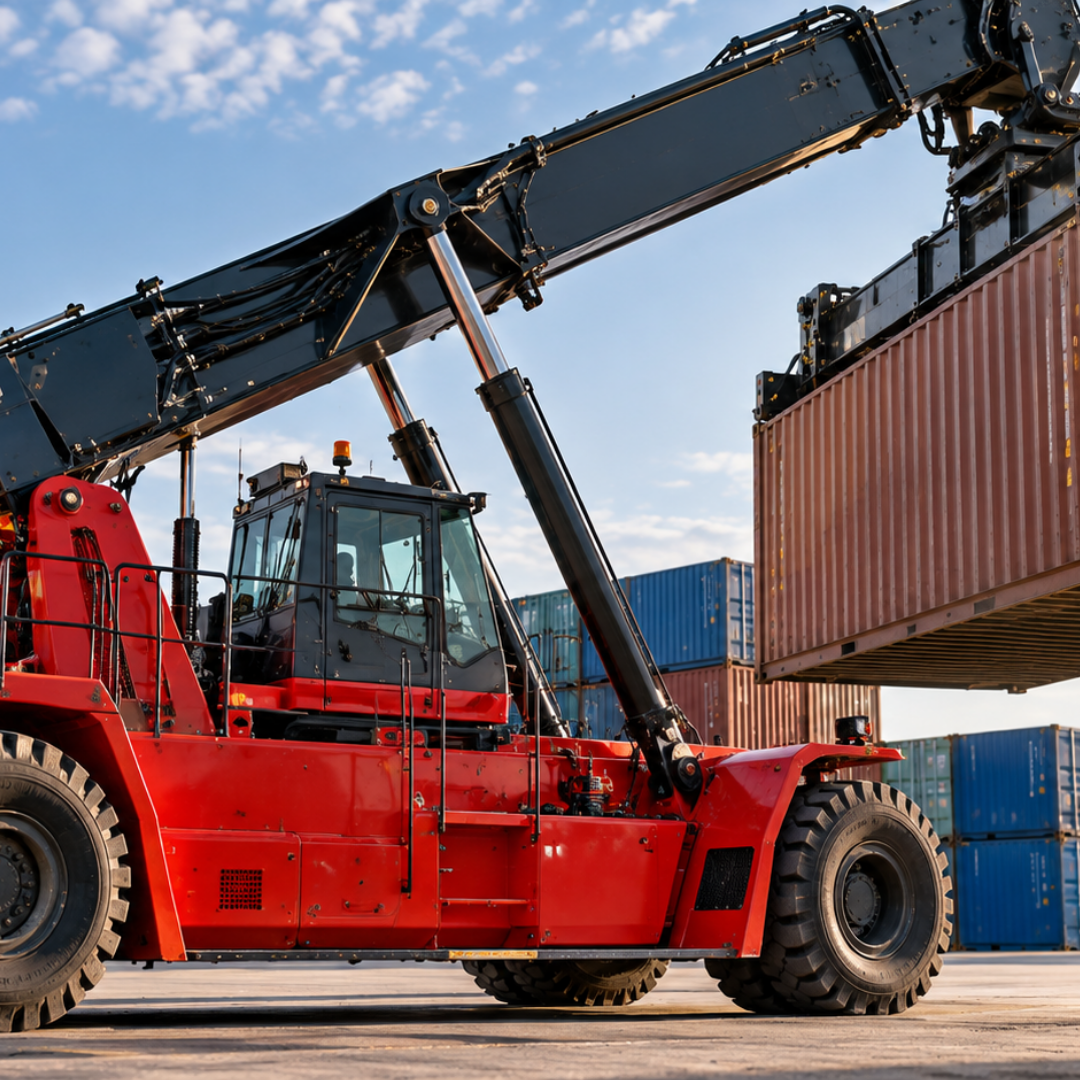
Material handling covers everything from a single-cylinder lift table to a reach stacker moving full shipping containers. The cylinders vary as much as the machines, but most share three jobs: lift the load, hold it, and lower it predictably.
The examples below cover common equipment types. For anything else that lifts, tilts, clamps, or positions loads, the same approach applies.


Lifting equipment leans heavily on a few configurations. The best fit depends on whether the load returns the cylinder, how much space is available collapsed, and how the circuit controls lowering.
Hydraulic lift, with the load's own weight bringing it back down under control, common on tables, mast lifts, and levelers.
Ram-style cylinders where the rod itself does the work, a straightforward choice for many lift functions.
Staged lift for high reach from a low starting height.
Pushes and pulls under pressure for tilt, side shift, clamps, and spreader functions.
Holding valves and lowering control mounted in the cylinder body, right where the load is.
Feedback for lift height, tilt angle, and automated handling sequences.
Design Considerations
In material handling, the hydraulic duty is rarely exotic. What makes these cylinders demanding is repetition, proximity to people, and very little room to work with.
Aurelius reviews these points with your engineering team before the design is settled.
Fighting leaks, drift, or rough lowering on an existing design? Send us the details, and we will help find a better cylinder answer.
Why Aurelius
Lift capacity is the starting point. How the load is held and lowered is where the engineering gets interesting.
Standard cylinders cover plenty of material handling functions. A custom welded design earns attention when collapsed height is tight, when lowering control or holding valves belong in the cylinder, when attachments need unusual mounts or porting, or when automated equipment needs position feedback straight from the cylinder.
Aurelius engineers study the lift geometry, the load cases, and how operators and automated controls use the equipment. Recommendations stay practical: the team looks for the simplest cylinder that meets the requirements and will point out where cost can come out of a design.
Shop practices back that up. Tubing and rod stock are inspected on arrival and rejected for finish defects, every cylinder is tested before shipment, and the people building them are trained for long careers at Aurelius.
A century of engineering work, dating to 1926, now backs Aurelius support for OEMs through development, launch, and recurring production.
Lift, tilt, side shift, and attachment functions can all be engineered as custom welded cylinders for OEM programs. Share the mast or attachment design, capacity, and envelope to begin.
Have lifting or handling equipment on the drawing board? Build a Cylinder and the quote form are both good places to begin.