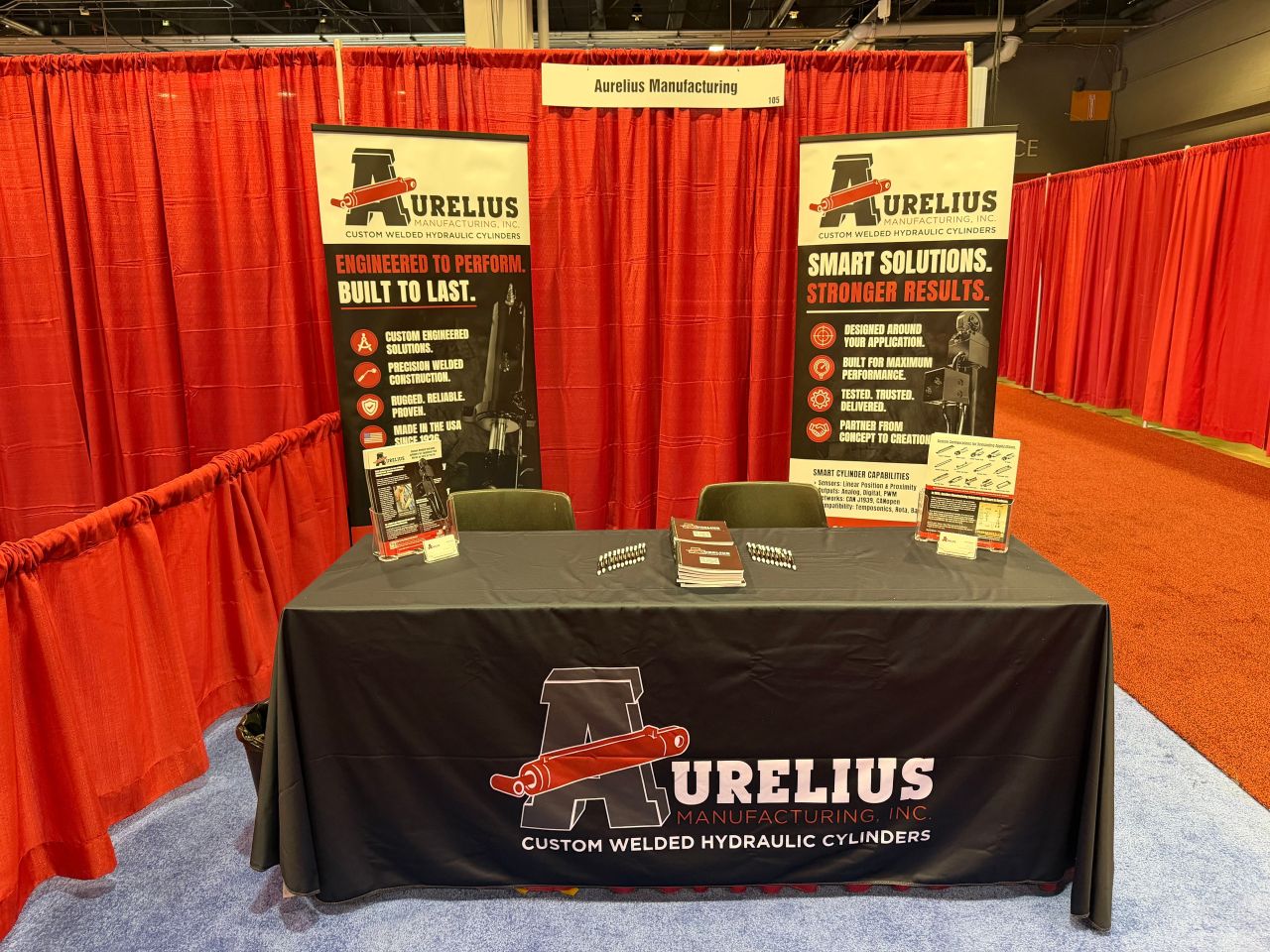


At Aurelius Manufacturing, custom welded hydraulic cylinders are engineered around application requirements
Hydraulic cylinders appear deceptively simple. Apply pressure, generate force, move a load. In reality, cylinder design is an exercise in balancing force requirements, structural integrity, mounting loads, buckling resistance, seal life, manufacturability, and cost.
For engineers designing mobile equipment or specialty industrial machinery, selecting the right cylinder involves much more than choosing a bore and stroke from a catalog.
This article reviews the engineering fundamentals behind hydraulic cylinder design and explains why custom welded cylinders have become the preferred solution for demanding applications.
The Foundation: Hydraulic Force
Every cylinder design begins with force requirements.
The theoretical output force of a hydraulic cylinder is determined by:
Force = Pressure × Area
For cylinder extension:
\(
F = P \times \frac{\pi D^2}{4}
\)
Where:
- F = Force (lb)
- P = Hydraulic pressure (psi)
- D = Bore diameter (in)
Example
A 4-inch bore cylinder operating at 3,000 PSI produces:
\(
A = \frac{\pi (4)^2}{4}
\)
\(
A = 12.57\ \text{in}^2
\)
\(
F = 3000 \times 12.57
\)
\(
F = 37,710\ \text{lb}
\)
or approximately 18.9 tons of force.
Of course, real-world systems introduce friction losses, pressure fluctuations, shock loads, and mechanical inefficiencies. Experienced designers rarely use theoretical force as their final design target.
Understanding Safety Factors
One of the most common mistakes in cylinder selection is designing too close to theoretical requirements.
A cylinder producing exactly the required force under ideal conditions often becomes a reliability problem in actual service.
Typical engineering practice applies a force safety factor ranging from:
- 1.25 to 1.5 for controlled industrial applications
- 1.5 to 2.0 for mobile equipment
- Higher factors for severe shock loading
Example
For example, if a machine requires 20,000 lb of force:
\(
20,000 \times 1.5 = 30,000\ \text{lb}
\)
The cylinder should be sized to comfortably exceed the design load rather than merely meet it.
Hydraulic systems are remarkably good at finding weak links. Engineers should strive to ensure the cylinder is not one of them.
Rod Size Matters More Than Many Realize
Bore size receives most of the attention, but rod diameter often determines cylinder longevity.
A larger rod provides:
- Higher buckling resistance
- Reduced rod stress
- Better side-load tolerance
- Improved seal life
- Increased resistance to impact loading
For compression-loaded cylinders, Euler's Buckling Equation becomes important:
\(
P_{cr} = \frac{\pi^2 E I}{(KL)^2}
\)
Where:
- (P_{cr}) = Critical buckling load
- E = Modulus of elasticity
- I = Area moment of inertia
- L = Unsupported length
- K = End condition factor
As stroke length increases, buckling capacity decreases rapidly.
This is one reason long-stroke applications often require larger rod diameters than force calculations alone would suggest.
Differential Area and Retract Force
Double-acting cylinders generate different forces during extension and retraction.
Extension force uses full bore area.
Retraction force uses annular area:
\(
F_r = P \times \frac{\pi (D^2 - d^2)}{4}
\)
Where:
D = Bore diameter
d = Rod diameter
As rod size increases, retract force decreases.
Designers must account for this when evaluating load conditions in both directions.
Side Loads: The Silent Cylinder Killer
Hydraulic cylinders are intended to transmit axial force. They are not designed to function as structural members or guide rails.
Misalignment and side loading can result in:
- Premature seal wear
- Rod scoring
- Tube wear
- Bearing failure
- Rod bending
Proper mounting geometry is often more important than increasing cylinder size.
Common solutions include:
- Spherical bearings
- Trunnion mounts
- Clevis mounts
- Improved linkage geometry
A properly aligned cylinder generally outlasts an oversized but poorly mounted cylinder.
Why Welded Cylinders Dominate Mobile Equipment
Historically, tie-rod cylinders were common in industrial environments.
Today, welded cylinders dominate mobile and off-highway equipment because they offer several engineering advantages.
Compact Package
Welded construction eliminates external tie rods, reducing envelope dimensions and simplifying installation.
Greater Design Flexibility
Custom welded cylinders allow engineers to specify:
- Unique mounting configurations
- Specialized port locations
- Integrated valve cavities
- Position sensing
- Custom stroke lengths
- Special materials
Improved Structural Integrity
The welded barrel and end-cap construction provides excellent resistance to vibration and shock loading common in:
- Construction equipment
- Agricultural machinery
- Forestry equipment
- Material handling systems
- Specialty industrial machinery
Optimized for Application-Specific Design
Instead of adapting equipment to a catalog cylinder, engineers can design the cylinder around the machine's exact requirements.
This often improves performance while reducing overall system complexity.
Porting Considerations
Port location and style significantly influence performance and serviceability.
Common options include:
- SAE O-ring ports
- NPT ports
- Code 61 and Code 62 flanges
- Tube line connections
- Port blocks
- Multi-directional ports
Poor port placement can create hose routing challenges, maintenance issues, and pressure losses.
Custom cylinders allow hydraulic connections to be optimized during the design phase rather than treated as an afterthought.
Designing for Real Operating Conditions
The best cylinder designs consider:
- Continuous operating pressure
- Pressure spikes
- Shock loads
- Duty cycle
- Environmental exposure
- Corrosion resistance
- Temperature extremes
- Serviceability requirements
A cylinder that performs flawlessly in CAD may fail prematurely if real operating conditions are not considered during design.
The engineering challenge is not simply generating force. It is generating force reliably for millions of cycles under actual working conditions.
The Value of Custom Engineering
Catalog cylinders serve many applications well.
However, specialized machinery often benefits from custom cylinder designs tailored to exact force, stroke, mounting, packaging, and durability requirements.
Custom welded cylinders allow engineers to optimize the complete hydraulic solution rather than compromise around standard dimensions.
At Aurelius Manufacturing, custom welded hydraulic cylinders are engineered around application requirements, with bore sizes from 1 to 10 inches, rod diameters from 3/8 to 5 inches, stroke lengths up to 20 feet, and operating pressures up to 5,000 PSI.
Because when the machine is custom, the cylinder probably should be too.