When the planting window opens, nobody wants to hear about a leaking fold cylinder.
Agricultural equipment works on the crop's schedule. A planter may sit in the shed for most of the year and then run day and night for a few weeks. A grain cart may haul load after load across rutted fields during harvest. When a cylinder fails in the middle of a planting or harvest window, the cost is measured in lost days in the field.
Implements also keep getting wider, heavier, and more automated. Folding booms and toolbars have to fit down the road, row units need consistent downforce, and operators expect functions to respond cleanly to tractor hydraulics and in-cab controls. Fertilizer, manure, silage, dust, and chaff work against rods and seals along the way.
Aurelius Manufacturing helps agricultural equipment manufacturers develop welded hydraulic cylinders matched to the implement, the tractor it connects to, and the season it works through.
Working on a new implement or a next-generation model? Bring Aurelius in early to shape the cylinders alongside the frame.
Agricultural Applications
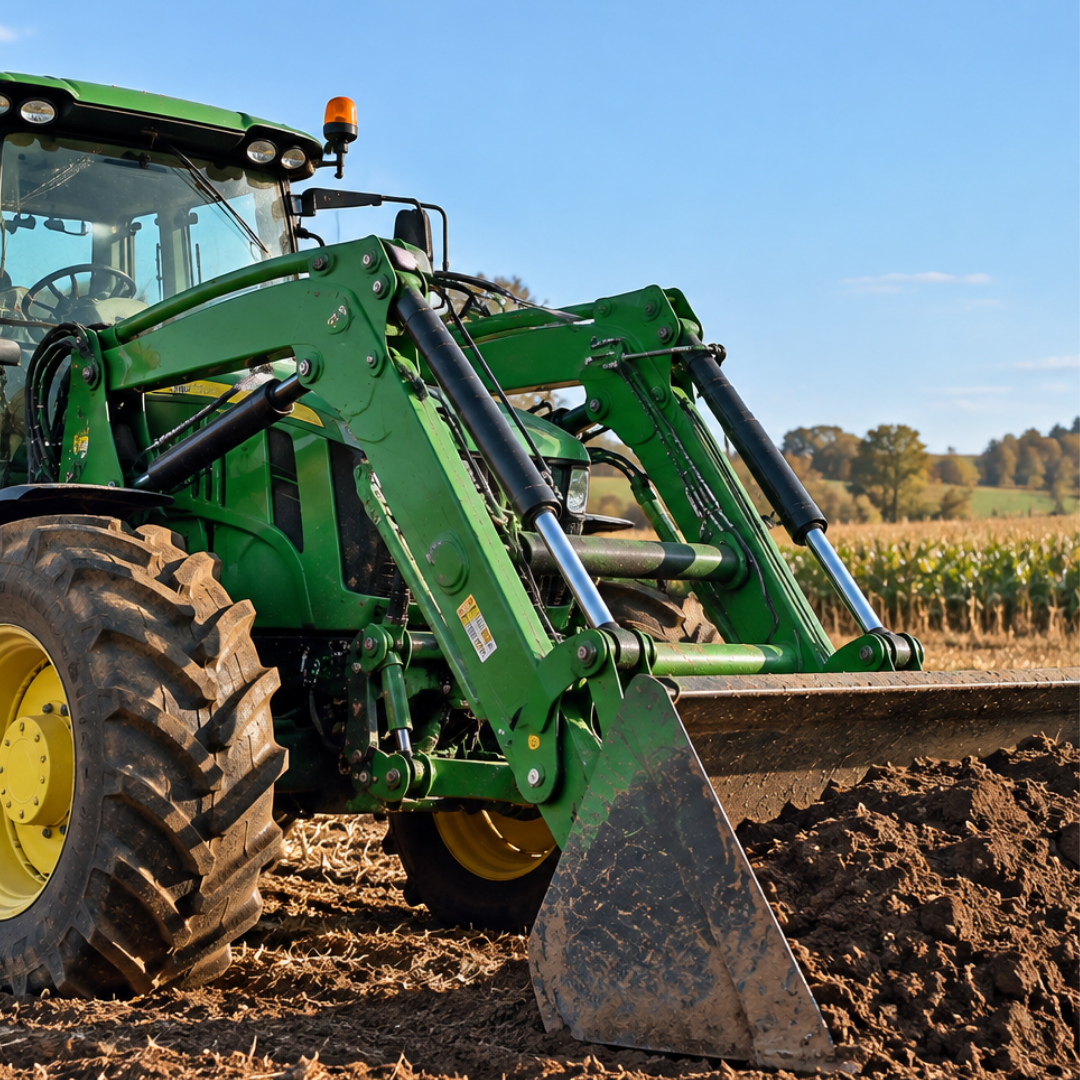
From spring planting to winter feeding, cylinders fold, lift, tilt, open, and position nearly every type of farm equipment. The demands vary widely. A planter downforce cylinder adjusts constantly in small increments, while a grain cart auger cylinder moves a heavy assembly a few times per load.
Use these examples to begin the conversation. If your implement is not listed, tell us what the function needs to do.


Agricultural equipment uses a familiar set of cylinder types, but the details change from one implement to the next. Aurelius can help choose and adapt the configuration for each function.
Lift cylinders connected in series that re-synchronize at full extension, so wide frames stay level.
Two-way powered motion for folding wings, booms, conveyors, and augers.
Powered stroke one way, with implement weight handling the return.
Feedback for boom height, row unit downforce, and automated folding and control systems.
Sequence, holding, or flow control valving in the cylinder to manage several functions on limited tractor remotes.
Decelerates heavy augers, wings, and gates before they reach full extension or retraction.
Design Considerations
Agricultural cylinders often look simple on a drawing. The challenges show up in the field: fold sequences, tractor hydraulic limits, corrosive materials, and a workload packed into a few intense weeks.
Working these factors into the design early helps the implement perform the way your customers expect.
Seeing cylinder issues in the field? Describe the function and what dealers are reporting, and we will review it alongside your engineering team.
Why Aurelius
Shortline or full line, the cylinder should fit your implement and your production plan.
Plenty of agricultural functions use standard cylinders successfully. Custom welded designs make sense when an implement needs specific mounts or port locations, when multiple cylinders must work together precisely, when corrosive materials shorten cylinder life, or when sensing and valving belong inside the cylinder.
Aurelius engineers talk through the function, the tractor interface, and how farmers use the implement in the field. Agricultural equipment is cost conscious, and the team looks for ways to simplify a design or reduce cost where performance allows, rather than adding complexity for its own sake.
Quality controls start at receiving, where tubing and rod stock with visible finish flaws are sent back to the supplier. Every finished cylinder is tested, and the long-tenured shop team is trained to spot problems before parts leave the building.
A century of engineering solutions, starting in 1926, stands behind Aurelius support for agricultural OEMs from the first prototype through seasonal production runs.
Yes. Aurelius works with OEMs building specialized equipment, including shortline manufacturers that need cylinders developed around specific implements. Share your application and expected volumes to start the discussion.
Ready to start an agricultural cylinder project? Begin with Build a Cylinder. A quote request with whatever details you have works too.