With a crew working at height, holding position matters as much as moving.
Line crews do not get to pick their conditions. A digger derrick may set poles on a frozen shoulder in January, and a bucket truck may hold a lineman beside energized conductors through a long storm restoration shift. The cylinders on that equipment have to move smoothly, stop where the operator stops them, and stay put.
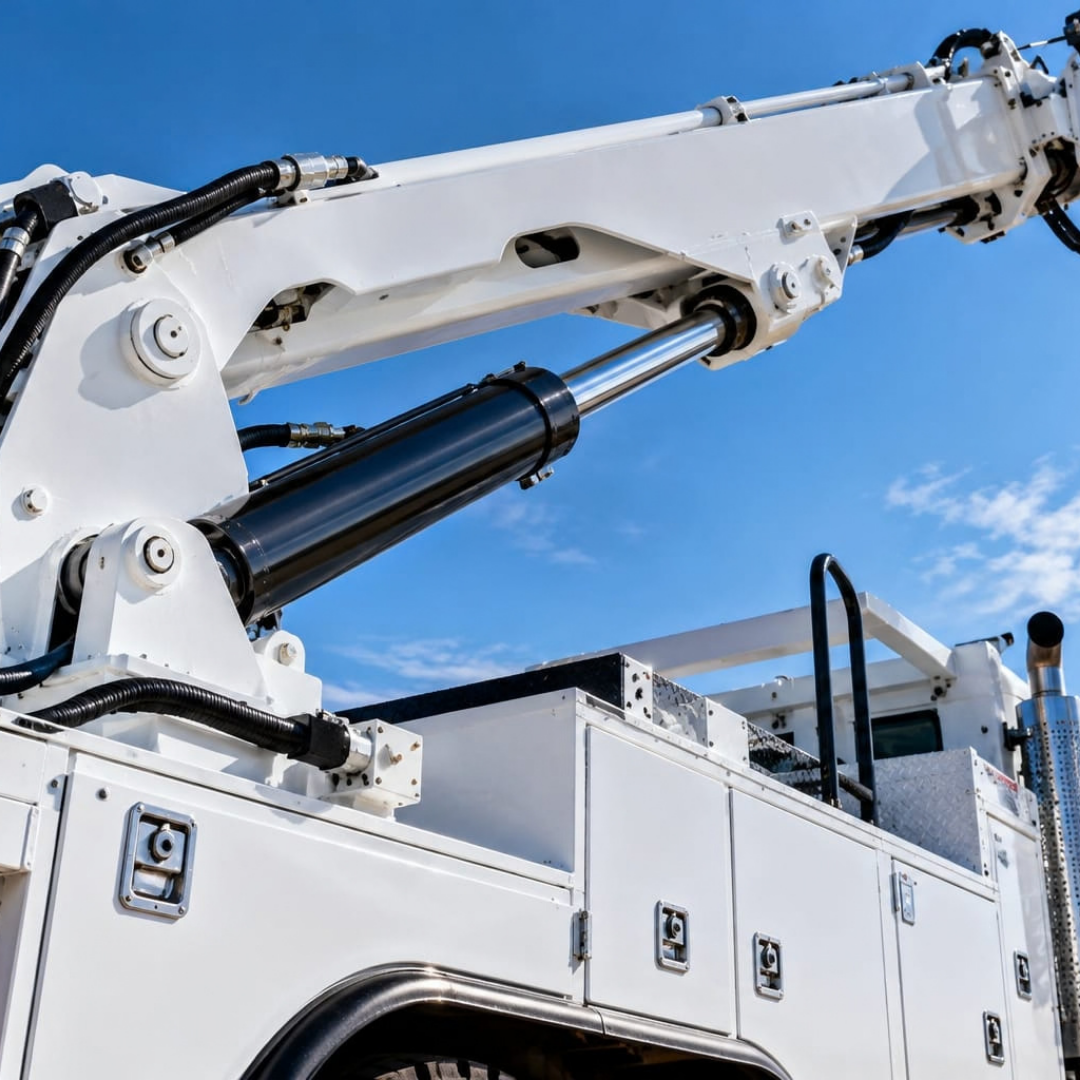
Space and weight are just as tight. Booms, outriggers, pole handling tools, and reel equipment share a truck chassis with tool compartments, hose routing, and payload limits. Many cylinders are installed inside or along a boom, where every inch of closed length and every port location is already spoken for.
Aurelius Manufacturing partners with engineers at utility equipment builders to design custom welded cylinders around these functions. The process begins with the mechanism and how crews use it, then moves to a cylinder that fits the structure, the hydraulics, and your production plans.
Designing a new utility body or boom? Talk with Aurelius before the cylinder envelope is locked in.
Utility Applications
Most utility trucks carry several distinct hydraulic functions, and each one loads its cylinder differently. A boom lift cylinder sees changing leverage through its arc. An outrigger holds a static load for hours. A pole claw has to grip firmly without damaging the pole.
The examples below are a starting point. If your equipment handles a function not listed here, the same review applies: loads, motion, mounting, environment, and controls.


No configuration is automatically right for a utility function. These are frequent starting points, and Aurelius can help sort out which one suits each mechanism.
Ports carried through the rod for extension cylinders installed inside a boom section.
Controlled force in both directions for boom lift, jib, and outrigger functions.
Series-plumbed cylinders that resynchronize at the end of stroke so paired cylinders finish each stroke together.
Cartridge valves and valve cavities in the cylinder for load-holding and circuit functions close to the actuator.
Slows the last portion of travel so booms, tilts, and stowed tools settle into position instead of slamming.
Integrated sensing for boom position, envelope control, and operator displays.
Design Considerations
Force and stroke get a cylinder started. On utility equipment, the details that follow often decide whether the crew ever notices the cylinder at all: how it holds a load, how it behaves in the cold, and how it fits a boom with no spare room.
These topics are worth working through early, while your engineering team can still adjust the structure and circuit around the answers.
Need a cylinder that fits a boom with no room to spare? Send us the geometry and the requirements, and let's work out the packaging together.
Why Aurelius
Start with the mechanism and how crews will use it. We will help shape the cylinder from there.
Catalog cylinders handle plenty of utility truck functions, and when they fit, they are a reasonable choice. Custom welded cylinders earn their place when a boom section leaves no room for standard porting, a leveling or extension function needs connections a catalog part does not offer, or the design calls for valving and sensing built into the cylinder itself.
Aurelius engineers ask how the equipment works before they talk about bore and stroke. The goal is a design that fits the mechanism, is practical to manufacture, and costs no more than the application requires. Projects can begin with a complete drawing, a cylinder you want to improve, or a function still taking shape on your design.
Consistency matters on equipment that carries people. Tube and rod material is checked for finish defects when it arrives, before it ever reaches a machine. Aurelius tests every cylinder before shipment, and builds with a long-tenured, well-trained shop team.
The company traces its roots to Braham, Minnesota in 1926, and that century of engineering work now supports OEMs from prototype cylinders through ongoing production.
Boom lift and extension, jib, platform leveling, outriggers, pole handling tools, auger tilt, and reel lift functions are all candidates for a custom welded design. The deciding factor is whether the function benefits from a cylinder built around its geometry and loads.
Have a utility application in mind? Start on the Build a Cylinder page, or send a quote request and tell us about the function.